What Is Product Strategy Really? The Mistake Junior PMs Make in Interviews
The Misconception That Trips Up Junior PMs
There’s a pattern I see repeatedly among entry-level and developing product managers — and it shows up clearly in interviews. When asked about product strategy, they talk about roadmaps. They talk about features. They talk about shipping.
And while none of that is wrong exactly, it’s incomplete in a way that signals junior thinking. If your mental model of product strategy stops at execution, you’re leaving out the most important part.
Product Strategy Is Not a Roadmap
A roadmap is an output of product strategy. It’s not the strategy itself.
Product strategy is the plan that puts your business on a path to making money. It’s the thinking that happens before you decide what to build — the work of understanding the market, the customer, and the opportunity well enough to make deliberate, high-confidence bets on where to invest.
Think of it like this: a roadmap without a strategy is just a list of things to build. A strategy gives that list a reason to exist.
What Product Strategy Actually Requires
At its core, strong product strategy is built on four questions:
Who is the customer? Not a broad demographic, but a specific, well-defined person with real behaviors, motivations, and constraints. The sharper your customer definition, the more targeted and effective your product decisions become.
What are their pain points? What frustrates them, slows them down, or costs them money right now? Pain points that are urgent and underserved are where product opportunities live.
Why do customers choose competitors today? Understanding what’s already working in the market — and why customers are loyal to existing solutions — tells you what the bar is that you need to clear.
Where are the gaps? Once you understand the customer and the competitive landscape, the question becomes: what isn’t being solved well enough? Is there a gap you can fill with a meaningfully better solution?
If you can answer those four questions clearly and connect them to a concrete plan, that is your product strategy.
The Three-Part Framework Interviewers Are Looking For
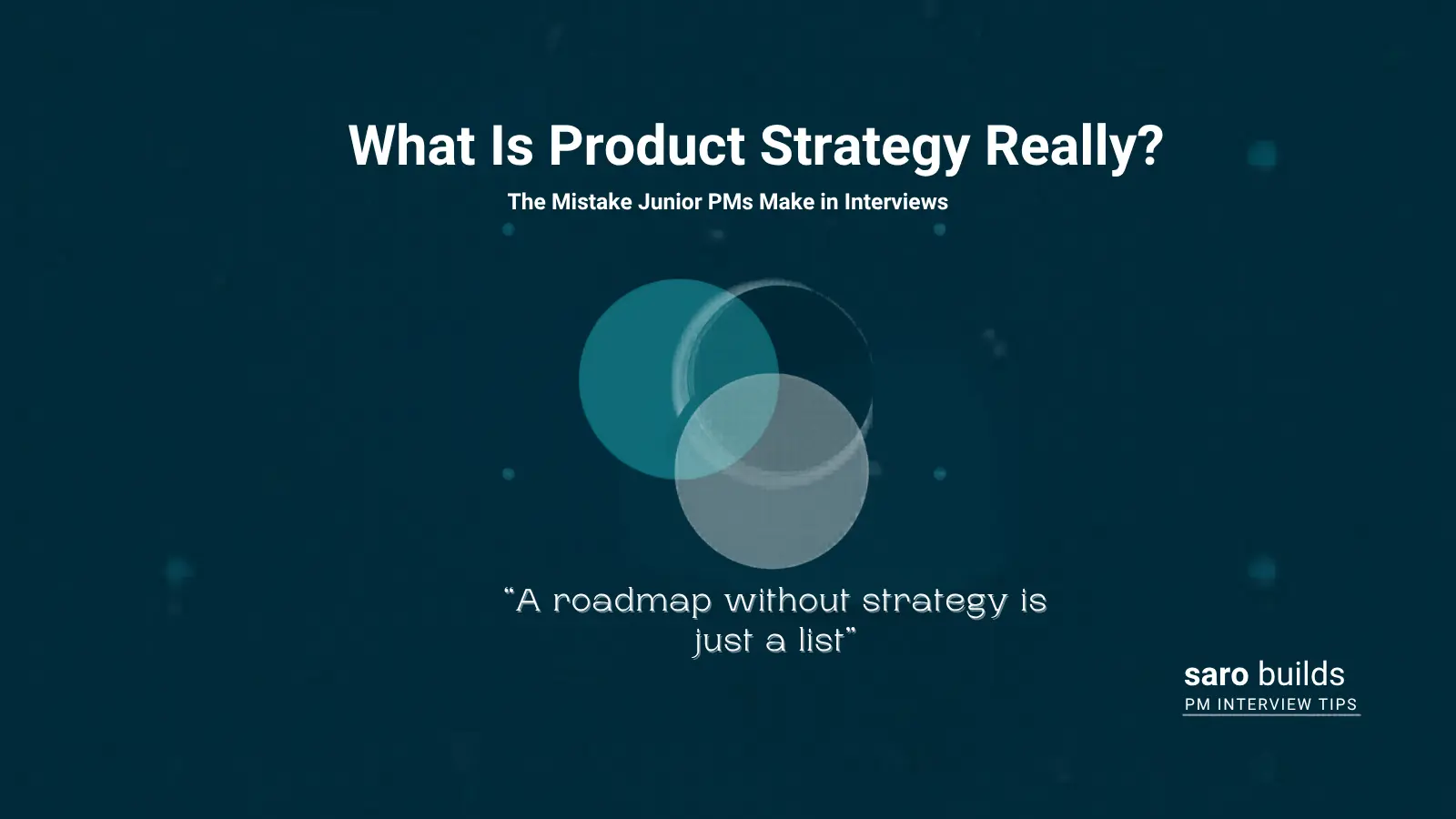
When a senior PM or hiring manager asks you about product strategy in an interview, they’re not looking for a list of features you’d ship. They’re looking for evidence that you can think across three dimensions at once:
Business strategy — How does this product create or capture value for the company? What’s the revenue model, the growth lever, the moat?
Technical strategy — What does the product need to be built on to support the business goal? What architectural or platform decisions underpin the vision?
Execution — How do you sequence the work, prioritize the tradeoffs, and actually get it to market?
Great product strategy sits at the intersection of all three. Candidates who only speak to one dimension — usually execution — struggle to make a compelling case that they’re ready to operate at a strategic level.
How to Apply This in Your Next Interview
Next time you’re asked a product strategy question, resist the urge to jump straight to “here’s what I’d build.” Start one level up. Define the customer, articulate the problem, identify the market gap, and then explain how your proposed solution bridges it — and why that creates business value.
That sequence signals strategic thinking. It shows the interviewer you understand that the roadmap is the result of good strategy, not the strategy itself.
If you want to practice framing product strategy answers that hold up under tough follow-up questions, send me a message about a mock interview session. We’ll work through real scenarios so your thinking is sharp before it counts.