The PACE Pyramid: A Framework to Ace Your Product Design Interview
The PACE Pyramid: A Framework to Ace Your Product Design Interview
If you’ve watched my breakdown of the product design framework, you probably have the outline down cold — the gates, the flow, the whole scaffolding. But let’s just admit it: in reality, that framework is only an outline. It tells you what to say, not how to show up. The candidates who actually get the offer aren’t the ones who memorized the most gates. They’re the ones who walked into the room prepared, composed, and unbothered by the pressure of the moment. That’s what this piece is about.
My name is Saro. I’m a builder, operator, and product and technology entrepreneur. I’ve spent over 20 years in the tech industry, including time at Microsoft, and I’ve held product leadership titles up through senior director and VP of product. Over that span, I’ve hired and coached dozens of product managers — and in more than a few cases, I’ve taken non-PM professionals like testers, designers, and engineers and helped them transition into product management successfully. This is a companion piece to my video on mastering product design skills, so if you haven’t watched that one, start there for the full picture. This one is about what happens once you’re actually in the room.
Why a Framework Alone Won’t Get You the Offer
Here’s the trap most candidates fall into: they treat the design framework as the whole game. They drill the gates, memorize the sequence, and walk in expecting the structure to carry them. Then they use it in the interview and come across mechanical — reciting steps instead of solving a problem with a real person in the room. Using the structure without adapting it to the moment makes you sound rehearsed, not ready.
That’s why I built a second layer on top of the design framework — something that governs how you show up, not just what you say. It’s called the PACE Pyramid, and I prescribe it to every student I coach.
Introducing the PACE Pyramid
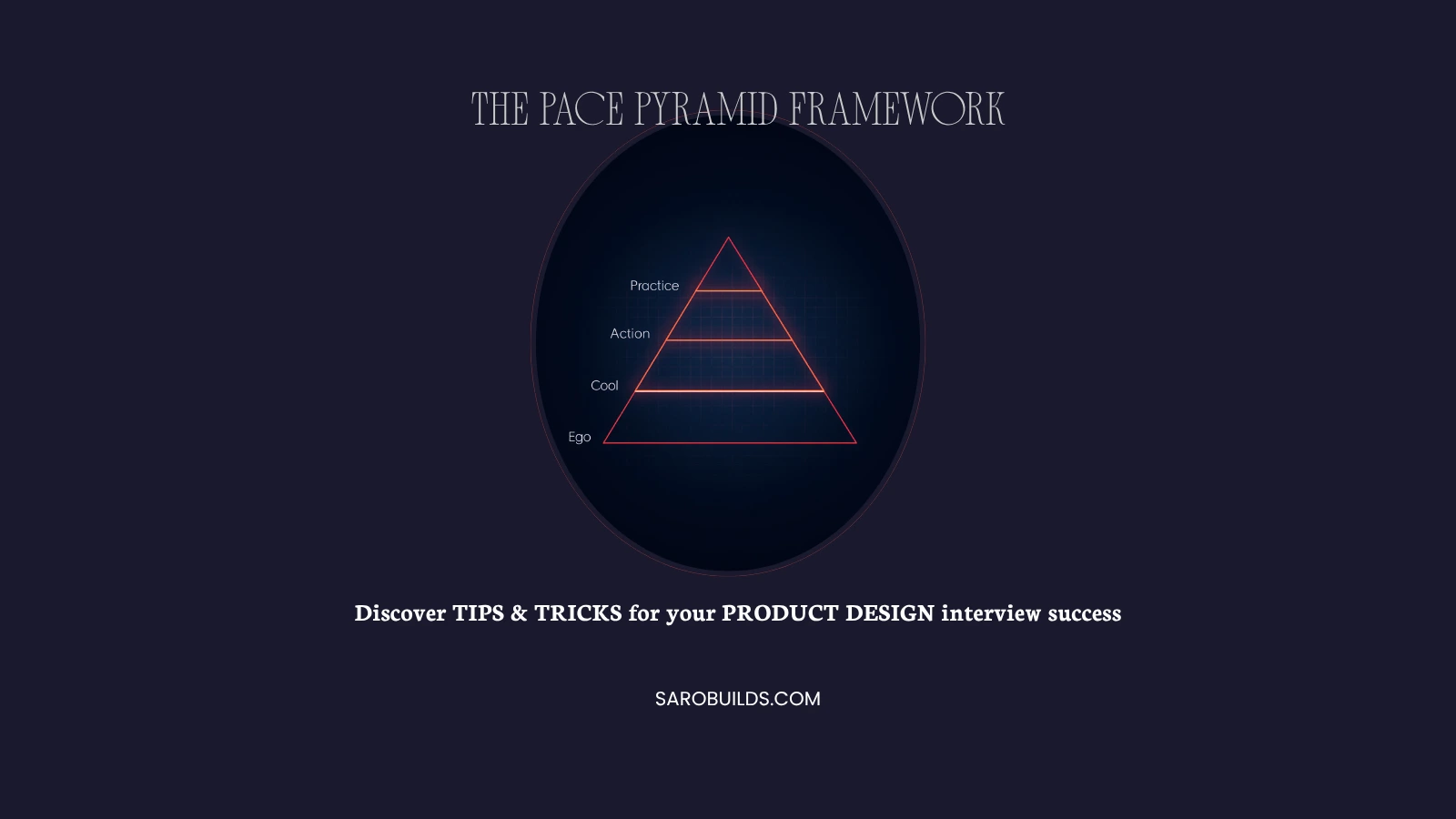
PACE stands for Practice, Action, Cool, and Ego — and it’s literally shaped like a pyramid. Practice sits at the base, because nothing above it works without it. Action builds on top of that. Cool sits above Action. And Ego caps the structure, because how you handle the outcome shapes whether you keep getting better or stall out after one bad interview. Think of it less as a checklist and more as a stack — each layer depends on the one underneath it holding steady.
Practice: The Foundation of the Pyramid
Treat the Interview Like a Movie
If you equate a product design interview to a mini movie, you’re looking at roughly a 40-minute runtime: two or three minutes for opening credits, thirty to thirty-five minutes for the body of the film, and the remaining minutes for the conclusion and end credits.
That’s not a lot of runway, which is exactly why time management is non-negotiable. If you’ve watched my video on the design framework, you know I encourage thinking about the problem in terms of gates. Do not spend an inordinate amount of time in any single gate — that’s a recipe for disaster. You have to move through each one and get to the other side. And here’s the part that surprises people: you don’t develop that sense of pacing by reading about it. You get it from practice, full stop.
Turn Everyday Moments into Reps
This is the simplest advice I can give you, and it’s much easier to act on than it sounds: turn everyday moments into practice. You’re in line at a coffee shop. You’re stuck in traffic. You’re waiting for a meeting to start. Pick any product around you and run the exercise in your head — who are the users, who are the buyers, why does this product exist, what problem does it actually solve.
This is how you build your product design muscle in the background, without ever opening a notebook. So when an interviewer puts you on the spot and asks, “How would you think about this?” — you’ve already rehearsed the motion. Breaking a problem down has become second nature by the time it counts. Practice time management, and look for every spare moment to flex that muscle. That’s the base of the pyramid handled. Now let’s move up to Action.
Action: How You Perform in the Room
Action is about what you actually do once the clock starts. And I want to give you the bad news up front: chances are, you’re going to get stuck. I’m not exaggerating. Getting stuck doesn’t mean you’re failing — it means you’re human, and interviews can be intense, tricky, and occasionally feel like a pressure cooker. It’s fine to admit to yourself, “I’m having a mini setback, but I’m going to bounce back.” Give yourself that room. Don’t let one shaky moment pull you into a spiral.
Ask Clarifying Questions Before You Solve
Almost every candidate who skips clarifying questions and jumps straight into a solution ends up failing — not because their solution was bad, but because they never confirmed what outcome they were actually solving for. You wouldn’t start driving without knowing your destination, and the same logic applies here. Slow down long enough to understand the problem before you start proposing answers.
Resist the Urge to Rush Solutioning
Measure Multiple Times, Cut Only Once
At Microsoft, we had a saying: it’s okay to measure multiple times, but cut only once. The intent is to use insight and gather as much information as possible so you’re crystal clear on what you’re actually building before you commit to it.
Don’t build out a solution before you’ve internalized the problem. Don’t propose an answer just to fill the silence — silence is fine. In fact, a bad idea said fast does more damage to your candidacy than a good idea said a few seconds later. Speed doesn’t win this round. Clarity does.
Cool: Keeping Your Composure Under Pressure
Ever heard the phrase “cool as a cucumber”? That’s genuinely the mindset that gets you through this stage. I’ve found three ways to hold onto composure during an interview, and none of them require you to be a naturally calm person — they’re just habits.
Reframe It as a Conversation, Not an Interrogation
I always tell myself before I walk into any interview: the interviewer is not there to get me. That single reframe changes the entire texture of the conversation. It stops being about the outcome and starts being about describing your thinking to the interviewer the way you’d walk a friend through an idea. It’s not a firing round, and the interviewer isn’t setting a trap. It’s a brainstorming session with someone who happens to be evaluating you.
Use Pauses as a Tool, Not a Failure
You don’t have to fill every second with talking. Use pauses deliberately. A pause isn’t dead air — it’s thinking time, and it reads as composure: “I’m collecting my thoughts. I’m not rambling. I’m going to think about what to say next.” That’s a far better signal than rushing into an answer just to avoid a moment of silence.
Show Your Structure Out Loud
Write your structure down. If you’re in person, use the whiteboard and walk through each stage one by one so the interviewer can follow your logic. On a Zoom call, do the same thing on paper and hold it up to the camera. You don’t need to be embarrassed about leaning on a visible structure — it helps you channel your energy into getting to the right solution instead of holding the whole framework in your head while also trying to sound articulate.
Ego: Playing the Long Game
Product design exercises are inherently compounding — they have a network effect. The more you do them, the better you get, the same way strength training works. So when an interview doesn’t go well, it’s worth remembering how many variables were actually in play. Maybe you had an off day. Maybe the hiring manager had an off day. Maybe you were a bad fit, or genuinely overqualified for the role. A lot of things could have gone into that outcome, and most of them have nothing to do with your ability.
Don’t let one rejection define your trajectory. Check your ego at the door. If it’s not this job, it’s the next one — and every shot you don’t take is a missed opportunity you can’t get back. Keep the ego out, and keep looking for the next better opportunity.
The Bottom Line
- Practice time management — no framework survives a candidate who burns thirty minutes in one gate.
- Ask clarifying questions before you solve — silence beats a fast, wrong answer every time.
- Treat the interview like a conversation — pauses read as composure, not weakness, when you use them on purpose.
- Keep your ego out of the room — one rejection is data, not a verdict on whether you belong in product.
That’s the PACE Pyramid: Practice at the base holding everything up, Action as how you perform once the clock starts, Cool as what keeps your composure intact, and Ego as what determines whether you come back stronger after a miss. Hold up the base, stay cool, and keep sight of what you can actually control — the rest tends to follow.
If you found this useful, I cover SaaS products, agentic AI workflows, and product thinking right here on SaroBuilds. Drop a comment or reach out — I’d love to hear what products you want me to review next.
#SaaS Insights & Product Teardown