How to Choose a Print-on-Demand Embroidery Provider: 6 Pillars That Decide Your Margins (Part 2)
SaaS Insights & Product Teardown
How to Choose a Print-on-Demand Embroidery Provider: 6 Pillars That Decide Your Margins (Part 2)
You’ve done the creative work. You’ve picked a product with real demand, and you have a design you’re excited about. Now comes the part that quietly makes or breaks your collection: choosing the print-on-demand embroidery provider who will actually produce it.
In Part 1, we covered how to select embroidered products that sell. This post is the operational half of the framework. I evaluate every provider through six pillars. All six are must-haves, but two of them are where I’d spend most of my diligence, and I’ll flag them as we go.
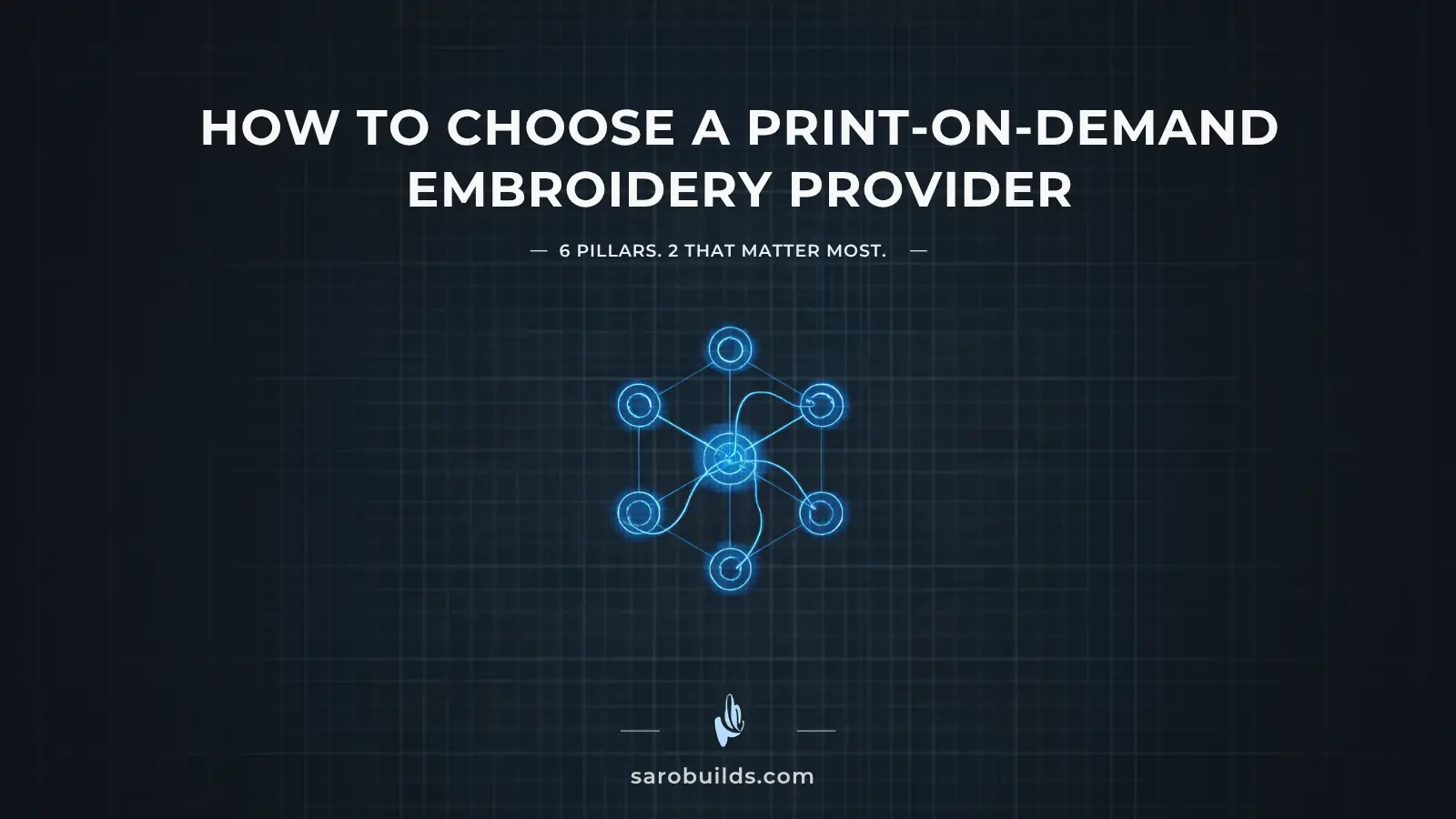
6 pillars. 2 that matter most.
Material quality, COGS, embroidery quality, returns, customer service, and shipping. Skip one and it tends to surface later as a refund, a bad review, or an ad budget that never pays back.
Pillar 1: Material Quality (Your Canvas)
When I say material, I mean the canvas itself: the fabric, the weight, and the feel in the customer’s hands. Think of it the way a painter would. The best artwork still looks wrong on a canvas that can’t hold it.
Your design should drive your fabric choice. A typical text-driven design, with bold lettering and simple shapes, is forgiving, and most fabrics will do the job.
Dense designs are a different story. Florals, which from what I’m seeing are a real fashion trend heading into late 2025 and 2026, pack a lot of stitches into a small area. On a thin or stretchy fabric, the stitching will pull and the fabric will pucker. For dense work you want a sturdier fabric that can carry the weight of the thread.
Pillar 2: COGS (Cost of Goods Sold)
COGS is a critical criterion, and it matters for two separate reasons.
COGS gives you margin leverage
If you price too low, chances are you’ll be in the red the moment you launch. And if you plan to invest in ads, you need a buffer on top of COGS that covers your profit margin plus room for marketing. Assume your collection will need marketing support, and don’t forget that when you’re comparing providers’ base costs.
COGS is tied to your pricing and positioning
This connects directly to the pricing discussion from the previous framework. Premium isn’t a function of positioning alone. It also depends on the quality you’re willing to offer, and a higher-quality product carries a higher cost of goods. You can’t claim a premium position on a bargain-bin cost structure, and you can’t afford a premium product at a bargain-bin price.
Pillar 3: Embroidery Quality
You can’t overlook this one. Embroidery quality is where the brand and the product can truly make or break. Based on my research, it breaks down into two things: the actual stitch quality, and the thread used to produce the final design.
Thread makes a visible difference
Premium thread versus cheap thread is a noticeable, visible difference, and your COGS will move accordingly. This is exactly why pillars 2 and 3 have to be evaluated together.
Check the provider’s thread palette before you finalize the design
Not every provider carries a wide range of thread colors or premium thread options. So when you’re building your design package, plan to fine-tune the design around what the provider can actually produce, rather than the other way around.
Not every design translates to embroidery
This one is worth saying plainly: not every design you come up with can be embroidered. Production runs through an automated, computerized setup, and it won’t match the fidelity or detail of a hand-stitched garment. If you’re sketching on paper or generating designs with AI and expecting the exact same output on fabric, I really doubt you’ll get it. Simplify, test a sample, and adjust.
Pillar 4: Returns and Defect Policy
If you run an e-commerce store, you already know returns come with the territory, whether you sell online or in a physical shop. With print-on-demand, the key question is what the provider will actually cover.
Most providers only cover defects, such as a misprint or a damaged item. Now run a simple scenario: a customer orders the wrong size or just changes their mind. In most cases, that cost falls on you, the store owner. That’s why I always read the fine print of the return policy before signing up with a provider, not after the first return lands in my inbox.
Pillar 5: Customer Service
I can’t stress this one enough. Having run a fashion brand and worked with suppliers, I know delays are going to happen. So are lost packages, bad fits, and sizing issues. When they do, some customers will be unhappy, disappointed, or flat-out frustrated, and you need a way to reach your supplier and make it right.
Look for providers with real agents and live chat, so you’re not stuck behind an email gate. Even if support isn’t 24/7, you want a meaningful response window in your time zone so you can talk to a real person and get to closure fast. A customer problem you can resolve the same day is a retained customer. One that sits for a week is usually a one-star review.
Pillar 6: Shipping and Processing Time
Shipping here means more than the package in the mail. It also includes processing time, meaning how long the provider takes to produce your item before it ever ships.
We’ve had customers order and tell us they’re leaving on vacation and need it within two weeks, and we’ve worked to rush it through. You can only do that if you understand your provider’s logistics timelines well enough to set expectations at the customer front.
Pay special attention during seasonal peaks and bulk orders for a single design, because that’s when things get weirder. Understand the processing timelines in advance and plan around them.
The Bottom Line: Pick the Provider That Fits Your Brand
Provider Selection Checklist
- Material quality: match the fabric to your design’s density, or the stitching will pucker.
- COGS: build in profit margin plus a marketing buffer, and remember higher quality means higher cost.
- Embroidery quality: evaluate stitch quality and thread options, and design around what the provider can actually produce.
- Returns: most providers cover defects only, so read the fine print on size errors and change-of-mind returns.
- Customer service: look for live chat and real agents in your time zone, not just an email gate.
- Shipping: know the processing time and logistics timeline, especially for seasonal and bulk orders.
Two of these pillars, both tied to quality, rank higher than the rest. But when you’re choosing a provider for your print-on-demand collection, weigh all six and pick the one that satisfies your brand’s actual needs, not just the one with the lowest per-unit price.
Coming in Part 3: we take this framework further and put it to work on real decisions. Stay tuned.
If you found this useful, I cover SaaS products, agentic AI workflows, and product thinking right here on SaroBuilds. Drop a comment or reach out — I’d love to hear what products you want me to review next.