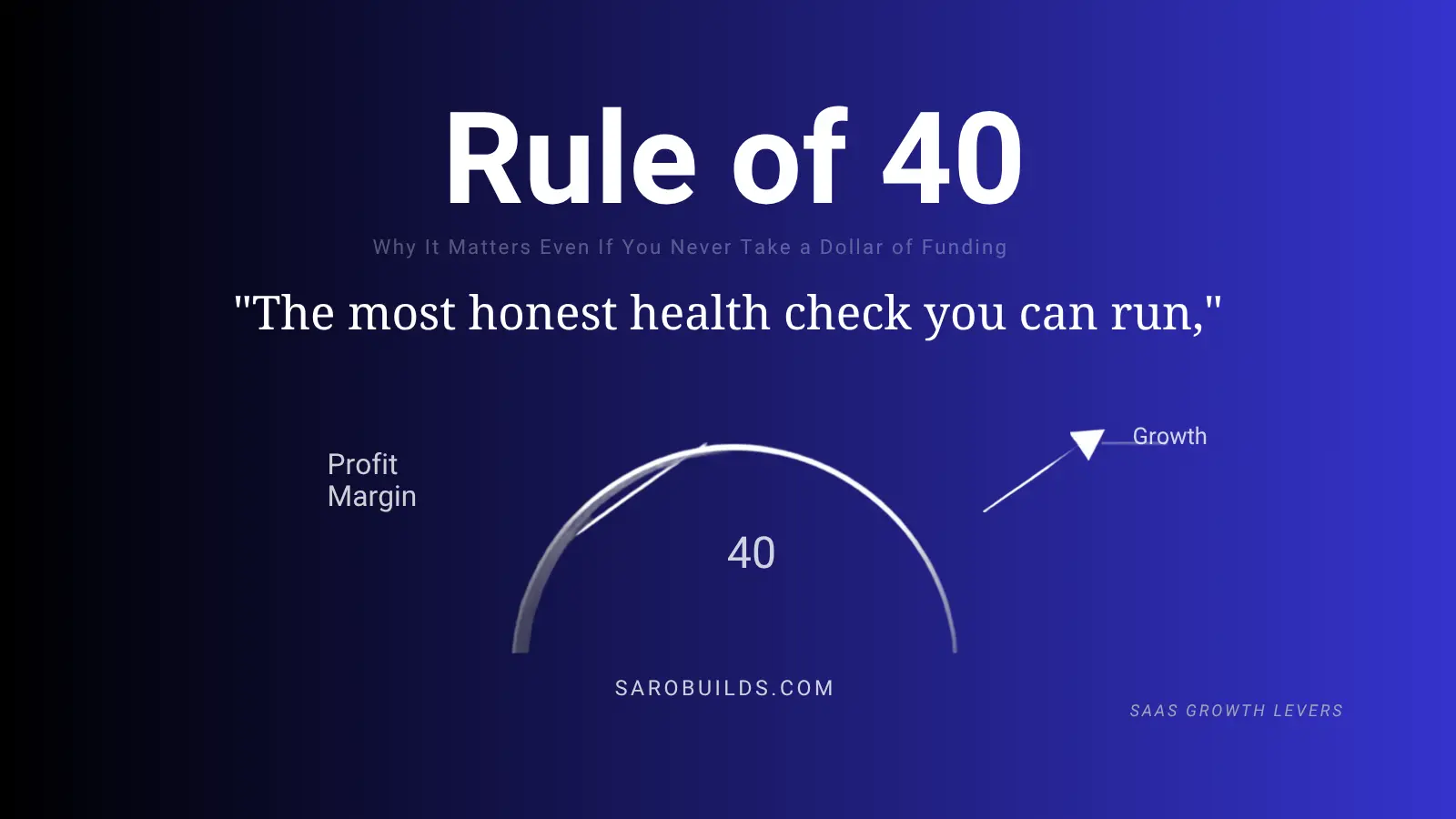
Rule of 40: Why It Matters Even If You Never Take a Dollar of Funding
Rule of 40: Why It Matters Even If You Never Take a Dollar of Funding
It’s pitched as a VC scorecard. It’s actually the most honest health check a bootstrapped SaaS founder can run on themselves.
Spend enough time around SaaS Twitter, investor decks, or any “State of SaaS” report, and you’ll run into the Rule of 40. It almost always shows up dressed as an investor metric — something VCs use to decide whether a company is worth the check. That framing is exactly why most solo founders and bootstrappers wave it off. No funding, no board, no term sheet — so why would this matter to me?
Here’s the reframe I’d push back with: Rule of 40 isn’t a fundraising metric that happens to be useful — it’s a business health metric that VCs borrowed because it’s a genuinely good way to catch a company lying to itself. And if anything, it matters more when there’s no investor around to bail you out of a bad trade-off.
What Rule of 40 Actually Is
Strip away the finance-speak and it’s a single trade-off, expressed as one number.
The logic: it’s fine to be unprofitable if you’re growing fast. It’s fine to grow slowly if you’re highly profitable. What’s not fine is being mediocre at both. The combined score forces those two levers to be judged together instead of admired separately.
The Two Failure Modes Rule of 40 Exposes
This is the part that makes the metric click for a solo operator — because both failure modes can produce the exact same score, which is the whole point.
Burn
60% growth, -30% margin. Score: 30. Feels exciting — orders up, traffic up, chart going up and to the right. But you’re funding that growth with cash you don’t have a refill source for. No investor round coming to top you back up. This is the failure mode that kills bootstrapped businesses fastest, because you can’t burn what you can’t raise.
Stagnation
5% growth, 25% margin. Score: 30. Feels safe — bank balance looks fine, nothing’s on fire. But the business is under-invested and quietly vulnerable to any competitor who’s still growing. Profitable stagnation is just a slower way to lose.
Same number, two completely different diagnoses. That’s why the single combined score matters more than either metric alone — it stops you from treating burn and stagnation as opposites, when they’re really two ways of failing the same test.
For a solo founder, translate it like this: burn is “I’m dipping into savings or credit to chase growth.” Stagnation is “I’ve been comfortable, but orders have been flat for six months and I’ve stopped experimenting.”
Why It Matters Even Without Outside Funding
The math has to work on its own
Funded companies can burn cash chasing growth because there’s a next round to refill the tank. Bootstrappers don’t get that safety net. Rule of 40 isn’t a vanity metric here — it’s your survival math.
It forces the trade-off into the open
Every dollar spent on ads, tools, or a contractor is a bet on growth versus margin. Instead of deciding on gut feel, Rule of 40 gives you a number to test that bet against.
It catches growth for growth’s sake
It’s easy to get seduced by more orders or more traffic while margins quietly erode underneath. This metric catches that before it becomes a habit.
It’s a founder sanity check, not just an investor pitch line
You don’t need a board to benefit from this. Run it on your own P&L monthly and treat it as an early warning system — no one else is going to flag it for you.
It makes you acquisition-ready, even if you never raise
If you ever want to sell the business, buyers benchmark against Rule of 40 whether or not you ever touched venture money.
It’s the only capital discipline check you’ll get
No board demanding capital efficiency means you’re the only check on spending. Rule of 40 gives you an external-feeling standard to hold yourself to, even solo.
It’s a useful lens for hiring and vendor decisions
Before bringing on a contractor or a new tool, ask: does this move my combined score up or down? It turns a fuzzy “should I spend this” question into something measurable.
Making It Practical
You don’t need investor-grade reporting to run this. Two inputs, both of which you already have on your own P&L:
- Revenue growth % — month-over-month annualized, or trailing 12 months
- Net margin or owner’s cash flow margin — what’s actually left after real costs, not gross margin dressed up to look better
Example: a DTC brand growing 25% year-over-year at a 10% margin scores 35 — five points short. The founder question becomes concrete: is it easier to find 5 points of growth (more ad spend, more SKUs, better conversion), or 5 points of margin (better COGS, fewer discounts)? That’s a decision you can act on this month, not a vague goal to “grow the business.”
Bottom line
- Rule of 40 isn’t about impressing an investor who isn’t in the room — it’s about not lying to yourself about whether the business is actually healthy.
- Burn and stagnation can produce the same score, but they need opposite fixes — know which one you’re actually looking at.
- Run it monthly off your own P&L. It’s one more lever to check before you scale spend, alongside a fuller framework like VALID for a complete teardown.
Frequently Asked Questions
Does Rule of 40 apply to bootstrapped SaaS companies without VC funding?
Yes. Rule of 40 was popularized by venture investors, but it measures the trade-off between growth and profitability that every business faces regardless of funding source. Bootstrapped founders arguably need it more, since there’s no investor capital to cover a growth bet that doesn’t pay off.
What is the Rule of 40 formula?
Revenue growth rate (%) plus profit margin (%) should equal or exceed 40. A company can hit 40 through fast growth with lower margin, high margin with slower growth, or any balance between the two.
Can a company fail Rule of 40 while looking financially healthy?
Yes. A profitable but slow-growing company can score the same combined number as a fast-growing but unprofitable one. Both represent underperformance relative to the benchmark, just from opposite directions — one is burning cash, the other is stagnating.
What’s the difference between burn and stagnation in the Rule of 40 context?
Burn is high growth funded by negative margin — spending more than the business generates to chase expansion. Stagnation is healthy margin paired with flat or minimal growth — the business is stable but under-invested and losing ground to competitors who keep growing.
How often should a solo founder calculate Rule of 40?
Monthly is practical for most solo operators, using trailing revenue growth and net or owner’s cash flow margin from the P&L. Treating it as a recurring check rather than a one-time calculation is what makes it useful as an early warning system.
Why do acquirers care about Rule of 40 even for companies that never raised funding?
Buyers evaluating any SaaS or e-commerce business use Rule of 40 as a quick health benchmark regardless of how the company was financed. A business that never took funding but scores well on this metric is still read as efficient and well-run by a potential acquirer.
If you found this useful, I cover SaaS products, agentic AI workflows, and product thinking right here on SaroBuilds. Drop a comment or reach out — I’d love to hear what products you want me to review next.
#SaaS Insights & Product Teardown